

Why upsizing in the GTA actually makes more sense in 2026 than it did in 2021
Friday Apr 17th, 2026
Why upsizing in the GTA actually makes more sense in 2026 than it did in 2021
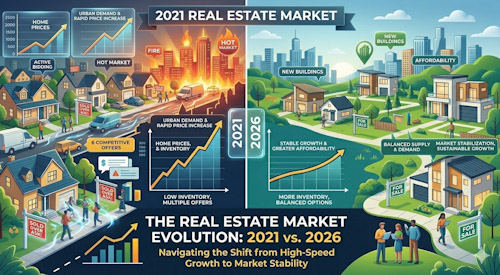
The market has shifted in your favour and most people don’t realize it yet.
If you’ve been sitting on the idea of upsizing in the Greater Toronto and Surounding Area, you’ve probably been watching the headlines with a mix of hope and anxiety. Prices are down. Sales are slow. The economy feels uncertain. And yet, counterintuitively, right now may be the single best window to make your move-up purchase that GTA homeowners have seen in years.
This isn’t about ignoring the risks. It’s about understanding the math. Because in 2026, the numbers actually favour upsizers in a way they didn’t in 202, even when prices were lower in absolute terms.
Here’s why.
1. The price gap has shrunk and that’s the only number that matters
When most people think about upsizing, they focus on the price of the home they want to buy. But that’s the wrong number to look at. The number that matters is the gap: the difference between what you sell your current home for and what you pay for your next one.
In 2021, that gap was enormous. Detached homes in the GTA were trading at peak prices, while condos and semis were also elevated but not proportionally. The cost to “upgrade” was at or near historic highs in many GTA communities, particularly in York Region and Halton, where the gap between a condo and a detached home exceeded $900,000.
In 2026, that picture has changed significantly.
|
|
The practical implication: if you’re selling a $620K condo and buying a $1.34M detached home, you’re losing roughly $56K on the sale compared to last year but saving approximately $96K on the purchase. The net result is that your upgrade costs you about $40,000 less than it would have 12 months ago.
As one GTA market analyst put it: real estate is relative. Waiting for your current home to recover in value while detached prices also rise doesn’t improve your position, it often worsens it.
2. Detached home sales are rising while condo inventory stays high
The spring 2026 market is sending a clear signal about where demand is heading.
|
|
Detached homes led all property types in sales growth in March, with the 905 region driving much of that momentum at 6.5% growth year-over-year. Meanwhile, condo inventory remains elevated, giving sellers of condos and smaller homes more time and negotiating leverage on their purchase side.
This divergence matters for upsizers. You’re selling into a segment where buyers still have negotiating power (condos, semis, townhomes), and buying into a segment where demand is returning but you’re still ahead of the full recovery. That window will not stay open indefinitely.
Semi-detached homes also offer a compelling middle step for upsizers not yet ready to stretch to a full detached price. In the 905, a semi-detached home costs roughly 25–40% less than a detached, while still delivering the space, yard and neighbourhood feel that growing families are after.
3. New mortgage rules changed the math for move-up buyers
One of the most overlooked shifts affecting GTA upsizers happened quietly in December 2024: the insured mortgage cap increased from $1 million to $1.5 million.
What does that mean in practice? If you’re buying a home in the $1.1M–$1.5M range — which covers a significant portion of move-up homes in the 905 you can now qualify for mortgage insurance with less than 20% down. This effectively reduces the barrier to entry for upsizers who may have equity in their current home but not a full 20% of a $1.3M purchase price sitting liquid.
Combined with the Bank of Canada’s rate path (now holding in the low 2% range), borrowing power for qualified buyers has been meaningfully restored since the peak rate environment of 2023.
|
|
4. The supply clock is ticking and 2026 may be your last window at these prices
Here’s the structural reality of the GTA housing market that rarely makes headlines: we are running out of new supply.
Construction starts for new Toronto condos dropped 51% between 2023 and 2024. New condo completions are projected to fall from roughly 31,000 units in 2025 to under 18,000 in 2026. The pipeline of new single-family homes across the GTA is similarly constrained by high construction costs and stalled projects.
At the same time, over 100,000 GTA households are currently sitting on the sidelines buyers who have qualified, who want to purchase, but are waiting for the right moment. When those buyers re-enter the market in the second half of 2026 and into 2027 (as TRREB’s Chief Information Officer has signalled), they will be chasing a shrinking pool of freehold inventory.
The families who upsize now buy ahead of that competition. Those who wait may find the detached home they want is suddenly $80,000 more expensive and competing with multiple offers again.
|
|
The bottom line
In 2021, upsizing felt exciting but it was actually expensive. The price gap was wide, competition was fierce, and many buyers overpaid for detached homes at the peak of the cycle.
In 2026, the emotional narrative is harder to shake (prices are “still falling,” headlines are cautious) but the financial case for upsizing has quietly become one of the strongest in a decade. Prices are corrected. The gap has narrowed. Supply is tightening. Mortgage rules have improved. And the buyers sitting on the sidelines won’t wait forever.
The question isn’t whether 2026 is a good time to upsize. The question is whether you can afford to wait until it’s obvious.
|
|
Market data sourced from TRREB Market Watch (March 2026), WOWA.ca, and Zoocasa. All figures are GTA-wide averages; individual neighbourhood results vary. This article is for informational purposes and does not constitute financial or legal advice.


Post a comment